 In much of the world, students don't learn "math" they learn "maths" — I think it's an apt way to think about mathematics, especially at Prairie Creek. We don't learn math in a single way at a single time but instead weave instruction into a variety of blocks during our day. In the coming week we'll begin our regular math routine and I wanted to share its elements with you.
Foundation Math
In foundation math, students develop fluency with computational approaches. Once students understand the underlying concepts of addition, subtraction, multiplication and division, they are ready to move to more efficient algorithms (an algorithm is a systemized approach to a problem). Not only does this enable them to tackle more complex problems, but it can also improve their accuracy.
We don't just have the students memorize an algorithm. It is very important they understand how and why an algorithm works to provide a correct solution. Students don't trust things they have just memorized and they won't use them in problem solving situations (nor will they remember it long). To truly own the math and use it creatively, they have to believe in it and deeply understand it.
We give students a formative assessment to help us create good groups to teach computation. When students are learning what they are ready for, they make exciting discoveries which they can share with their peers. If computational instruction is too much review, students check out and become bored; conversely, if they don't yet have a conceptual understanding of the operation such as multiplication, they don't have a framework to base their understanding on.
 Exploration Math
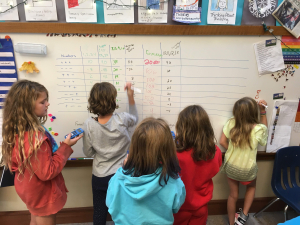
In exploration math, we explore concepts through more open ended tasks. Discussion and debate are a large part of the learning. There are many pathways to solutions and students are encouraged to record their work carefully and be prepared to explain their work to others. We sometimes call ideal exploration tasks "low threshold, high ceiling" meaning that all students can find a way to engage with the math and that there are rich directions to take the math as students further their explorations.
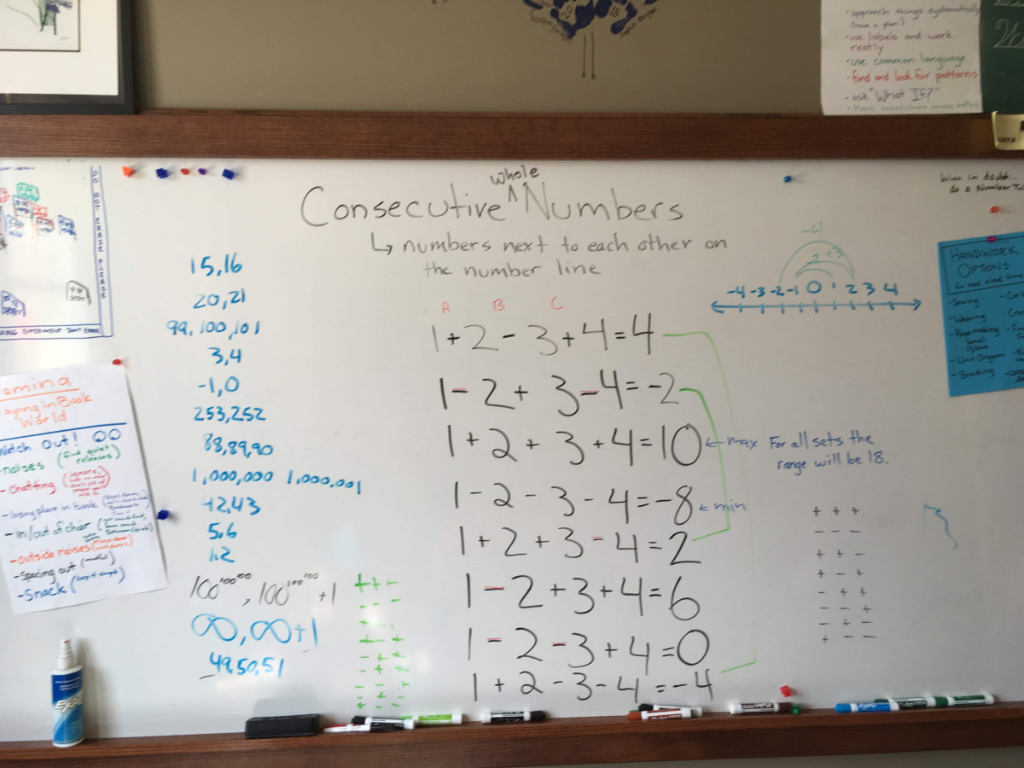
On Friday, for example, I introduced a study of consecutive whole numbers. Our work began with defining "consecutive" and "whole" and then we began to combine four consecutive numbers by adding or subtracting them. For example, we could combine 1,2,3,4 by adding them all, 1+2+3+4=10 or subtracting, adding, subtracting 1-2+3-4 = -2. Children were asked to figure out all the ways to combine the four numbers. How did they know they had them all? (Proving this requires a systemic approach and organized work — two big goals for 4/5 math.)
Then we set to work collecting as many examples as we could on a chart. Suddenly a pattern occurred – no matter what the numbers were subtracting, adding then subtracting yielded -2! How could this be? Some of the kids continued to find more examples in positive numbers, one group tried mixed numbers (still works!), another tried consecutive tenths (.1,.2, .3, .4) still works (but it's -.2) another tried numbers across zero (works!) another tried negatives (got stuck on what to do when you subtract negatives…what an opportunity to teach them something new!). Still others began to try to puzzle out why this was happening.
Whew. The energy and excitement were palpable. Students were loathe to stop their work, indeed, I let math go way over time.
Number Talks
We added number talks to our numeracy work several years ago and they have become an invaluable tool for developing number sense, building students' ability to explain and generalize math thinking, and assess student understanding. All number talks pose a mental math problem which students independently solve. We put all of the answers they got up on the board and then students explain their paths to a solution. Students listen carefully to others' approaches and find connections (or disconnections). Often, a debate develops about the validity of one approach or another ("does that always work or does it just work for these numbers?"). VERY often, students have an "oh!" moment (which they show us with a hand signal) when they figure out a mistake in their thinking. I have been amazed with students' willingness to share these moments with peers to help us all learn. We talk often (the Herons would say, "ALL THE TIME") about the power of mistakes for building our understanding and even making more connections among our brain cells.
Fluency Focus
We spend a few minutes each day building our fluency. Having math facts readily available in one's stored memory frees up working memory for more interesting work. The more basics we have memorized, the more readily we recognize patterns and relationships and the less likely we are to make errors in larger computations. When I took my math class this summer, it was clear a lot of folks had more math facts at their fingertips than I did — I have to work on my prime factorizations! For the Herons, fluency with addition, subtraction and multiplication facts is crucial. In fifth grade, we add division facts and certain fraction/decimal/percent relationships. What does fluency mean? It means not having to stop to figure out a fact from scratch. If you see 7×6 you shouldn't have to count by 7s, (or 14s or 6s or 12s). Instead, "42" should pop into your head, or, perhaps "7×7=49 and this is 7 less so 42" or, maybe "3 sevens is 21 so this is 42". If one is fluent, one doesn't have to do a lot of thinking and your brain is freed up for more creative math.
Data Analysis
As much as possible, we try to examine authentic data. We'll collect data about our class, science experiments, and phenology. We'll graph that data in ways that make relationships and trends more apparent. We'll analyze the data to find mode, median, average, maximum and minimum – making sure that we aren't just finding those landmarks but thinking about what they mean. For example, last year we took a data set of the dates for peak fall color in Grand Rapids in the last thirty years. We graphed the data and then figured out when we would be most likely to see peak color, what the earliest date might be and the latest and how many days we would have to plan a trip for to make sure we saw peak color (that's the range.) Using data for authentic tasks helps students understand how math can give us a deeper understanding of a phenomena.
Wonder Math
While I hope that every math lesson has an element of awe and wonder, some days we'll also explore large math concepts that blow our minds. Topics like networks, topology, and knot theory are often not explored until college but are accessible to fourth and fifth graders. Giving students an opportunity to "play" in these areas helps them understand that math is much, much larger than computation. They love tackling problems that "no one has ever found a solution to" — I am amazed by their fearlessness.
In Fermi math, we use math to make explore the world around us in a light hearted way. My current favorite thing to ponder…how big of a swiming pool would you need to swim in $15,000,000? We develop questions about a situation and use math and logic to make valid estimates. It's another great way to play with math.
We'll talk more about all of these facets of math instruction at curriculum night but I wanted to share a big about the math world your Heron will inhabit.



Leave a Reply