Close Reading
This week we read the last newspaper in our Pre-Revolutionary America theme. The Battle of Lexington and Concord shifted the debate in the colonies and the rag-tag underground Sons of Liberty made way for Washington's Continental army and open rebellion. Together, we read the first part of the Declaration of Independence. The language is challenging and the syntax is dense so I modeled close reading, a technique in which you move word by word through a text and parse the meaning piece by piece. On the overhead projector (yes, an overhead projector) I marked up my original and they followed my lead:
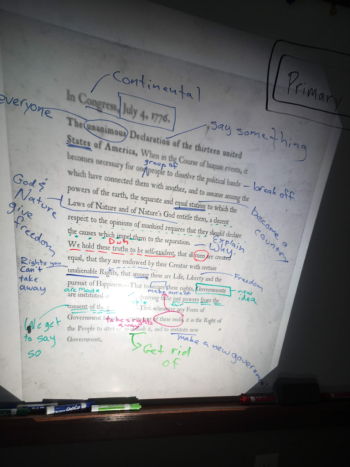
The students then split into pairs and tried their hand at a close reading of the grievances that the writers of the Declaration felt "impelled" to list. They did an amazing job. Wading through the complex text, they recognized many of the outrages they had read about in our role play: quartering soldiers, lack of fair trials, excessive taxes, having no say in government, being controlled by the military. They even figured out some new grievances – such as forced conscription. I was very impressed with their willingness and ability to wrestle with the words and puzzle out their meaning.
We also had a chance to wrestle with some of the paradoxes of the Declaration. "We hold these truths to be self-evident, that all men [emphasis mine] are created equal…" The Herons knew that even at the time, people knew this statement wasn't inclusive. We had read a letter by Abigail Adams in which she implored her husband to, "remember the ladies" as he helped to write the documents that would become the foundation of a new country. Other delegates wanted to include Anti-slavery language which was ultimately taken out so that all of the nascent states would sign on to the rebellion.
Our history is not simple. The founding documents are riddled with language and systems that de-humanized people ("merciless Indian Savages" in the Declaration, for example) and yet the vision for a government of, by and for the people was, truly, revolutionary and continues to inspire oppressed people everywhere — even here. Indeed, the Declaration was used as the basis of the Declaration of Sentiments the founding document of the U.S. women's suffrage movement. The Herons proved themselves ready to consider that duality.
Just this weekend, I heard an interview with Filipino author and teacher, Gina Apostol in which she talks about this more eloquently than I:
You hold these tensions in your country, and it is good for you. It is good for you to recognize the liberatory aspects of the "saving principles," as Frederick Douglass called them, and it is good for you to recognize that there was inhumanity in our original Constitution — that there was a three-fifths clause, that there was a normalizing of genocide against Native Americans. And to hold those together, and to confront that daily — it's really very difficult — but to hold those tensions together is a way to be a healthy American…So I teach these things to my students, and I think that we should use these liberatory aspects of the founding documents to counteract the inhumanity that is also part of this history
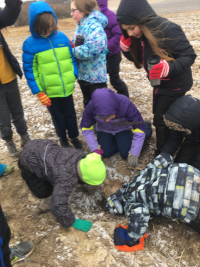
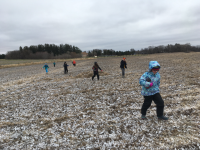
What might not bode so well was the Herons' eagerness to check out a giant hole during our Forest School ramble. In the
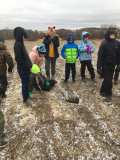
end, it was their teacher who put her hand (and phone) down the hole to get a closer look (after discouraging a child from sticking his head in the hole). The whole was about 25 cm (10 inches) across and had a wide dirt field "porch" in front of it. It was dug in sandy soil at the top of a hill in a farm field. It went down about 70 cm (an armslength) where it seemed to branch in two directions. Thoughts? Our guess was ground hog or badger but we haven't yet found a definitive answer.



Leave a Reply