I'm trying not to look at calendars – the amount of change in the past month is overwhelming. It is humbling and exhausting to be trying to bring our Heron classroom online. As a first year teacher, you often spend more hours planning than you do teaching and I've found that to be true again. I am creating systems and content. In the absence of routine, I'm planning meticulously. I'm trying to invent new traditions. I'm throwing a lot of things on the wall to see what sticks. I'm making a lot of mistakes.
One of the greatest challenges is bending these on-line tools to our school's progressive will. They are tools that are designed for extrinsic motivation – grades, mostly. They're analogous to reams of worksheets waiting for gold stars. Some of them have really good content, but without being able to wander among the tables to provide encouragement, context and instruction, I find that often the students get frustrated or blast through things without giving it much thought just to be able to check it "done." (Today I had a student ask if watching a video or getting a hint would affect his score.)
It's not true that progressive education only uses "intrinsic" motivation. I've only taught a few kids who were purely intrinsically motivated. They were amazing, but they also never did anything unless they felt like it. These creative maelstroms would listen to a carefully planned lesson and say, "Hmmm…I think I'm going to do this instead." No amount of cajoling, praise, threat or puppy eyes would shift them (and grades weren't a much more successful motivator later on.)
So if most kids aren't purely intrinsically motivated at Prairie Creek, how are they motivated? I've "had more than one visitor wonder why the kids are working so hard if they don't get grades (or candy.) "How do you get them to do work when it doesn't 'count'?"
This past week has brought in to sharp focus the power of relationships. Relationships live in the space between purely intrinsic and extrinsic motivation – indeed, they literally fill the spaces between the us. We build classrooms in which the drive to work comes from the respect we have for one another. The expectation is that we are together to learn and create and play. I model engagement and excitement in the classroom and, because of the relationships we've nurtured, the students want to do the same. I don't use fake praise to motivate kids – but I definitely share in their excitement when they've done a good job, when they've worked really hard, when they've figured something out.
And now they are so very far away. I rely on quick smiles, crinkled up noses, and furrowed brows to see how things are going and urge kids in to new challenges. A well placed, "You've got this," can help a kid tackle the hardest things. A smile and a, "is that your best work?" can engender a smirk and re-engagement. And an excited "ooh! ooh! ooh!" can inspire a kid to go above and beyond. All of those tools are gone (or at least mediated through a tiny screen).
In an effort to make sure work and expectations are clear, I've created checklists which seem to shift the conversation to, "What do I have to do" instead of "what do I get to do." Google Classroom, Khan, and CommonLit amplify the impact by measuring kids' progress in "turned ins" I am conflicted. Abandoning a checklist all together would put the burden on parents to provide an enriched environment in which students are choosing from among many options (but needing a lot of interaction and feedback.) That's not a fair ask. You'd be doing my job.
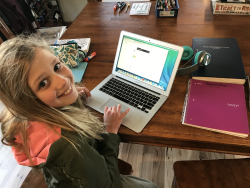
So I inch forward. Tools like FlipGrid provide opportunities to share and celebrate work in a genuine way. Students are beginning to use the technology creatively and are making new traditions every day. I'm hanging out in our Zoom Room for hours, encouraging students to stop by with questions or work shares (or life shares). It's the closest I can come to being in a real classroom. The more chances I get to connect, the more I can use relationships to motivate learning and the deeper I hope the learning can be. It won't be the same – but it can still be good. I know it can because your kids are amazing.




 The Rookery
Leave a reply to Lisa Percy Cancel reply