It is very difficult to write or speak succinctly about progressive education but, when I'm asked to, I talk about authenticity. Teaching progressively means that the students feel that what they are learning is real and means something. There are many ways to create authentic moments in the classroom, but one of the most joyful is serendipitous learning.
Serendipity is defined by Oxford as "the occurrence and development of events by chance in a happy or beneficial way." Serendipitous learning is learning that happens seemingly by chance (more on that "seemingly" in paragraph 7). We discover and explore something together as a class. The unexpected has happened and we feel a need to figure it out. An example from this week:
As we settled in to read aloud in the meeting area on the first day, a drop of something fell on a student as she came into the meeting area. "Something dripped on me!" Suddenly all eyes went up. "That tube has lots of drips on it!" "Is it leaking?" "Is it water?!?" I asked the students to share what they noticed. The drops were in a line at the bottom of the tube. The tube had an air vent in it so where was the water coming from? I asked them if the tube was going to be hot or cold – almost everyone thought hot. We sent the tallest Heron up on a chair to test, "Cold!" She reported.
Hmmmm. The windows were open (even with the air conditioning on, I like to encourage fresh air circulation) and it was a warm humid day. I asked the student to hypothesize where the drips were coming from if it wasn't leaking out of the tube. "The air?" What do you mean? "Like rain comes out of the air." There was a lot of excited chatter as the Herons considered this. Several students volunteered how the air has water in gas form in it — I drew up a diagram on the board to illustrate what they were talking about. "So how does the water get from gas form to drips?" Eventually we got to thinking about temperature – it's very cold high in the sky where clouds form and the tube was cold to the touch. I shared that warm air can hold a lot more water than cold air in gas form and the Herons has an epiphany. The tube was cooling off the air and the water was coming out of it. "CONDENSATION!" one student yelled. Another followed with evaporation. We drew the water cycle on the board. "We have our own mini weather system in the Herons." So cool. Now on to the read aloud.
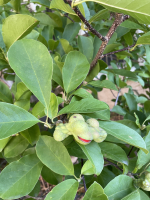
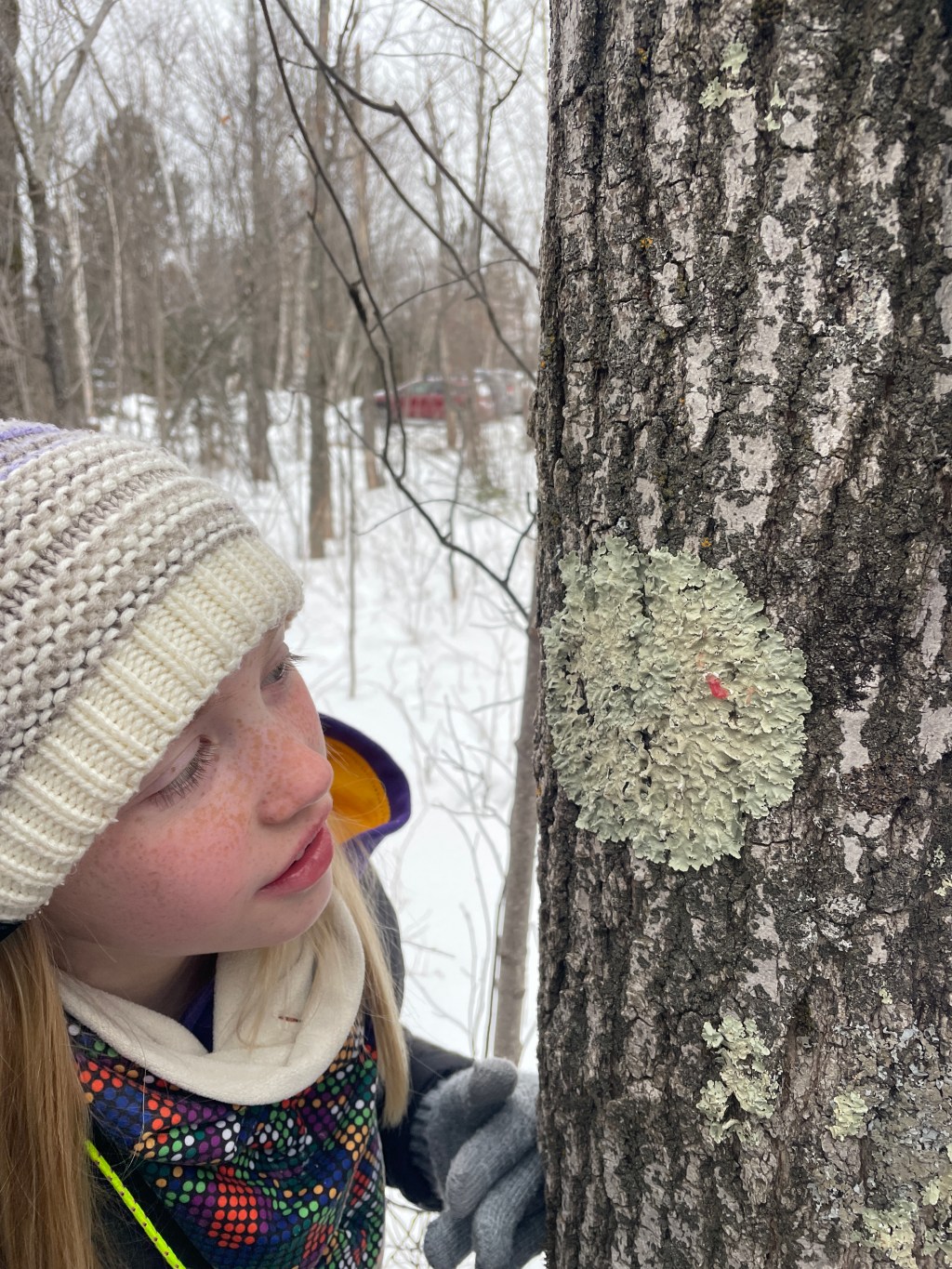
One of the reasons we began forest school was because of the way it engenders serendipitous learning. We never know what we are going to find outside. Just this Wednesday, we discovered three different kinds of bumps on the underside of oak leaves. What were they? iNaturalist said they were galls. I gave a quick mini-lesson on what galls were (fifth graders were already on the lookout for goldenrod galls and the tasty grubs they hold). These galls were too small for us to find a grub. What could be in there? Students build a bar graph out of the leaves they were finding separated into the three different kinds – there were a lot more white fuzzies. Then we saw a small solitary wasp on one of the leaves. Was it laying eggs? How could we tell? (It flew up too high to observe, sadly.)
Another group called us over the the magnolia tree. It has strange globby growths at the ends of the branches. Were these galls? One of them seemed to be splitting open and had a bright red thing popping out. A seed? We dissected it to learn more. Students remembered that the flowers were at the ends of the branches and that flowers often turn into fruits…this seemed to be a very strange seed. "Can we plant it?"
Ironically, serendipitous learning doesn't actually just "happen" even though it feels that way to the class. As a teacher, I am constantly watching for the opportunity to bring something unexpected forward. I try to create an environment in which we are noticing things all the time and I'm ready to ask the questions that bring us from noticing to understanding. The class, too, has to learn to go with the unexpected. Sometimes we're even conspiratorial about it, "I know we're supposed to be doing this but this other thing is amazing. Let's go that way for a while and then get back to our "supposed to." (A secret? A surprising number of our serendipitous journeys actually are standards based (one has to really know the standards to teach progressively because you are always watching for the best moment to bring something forward.))
I, too, have to be learning along side the class to make the learning truly authentic. I'm modeling curiosity and, importantly, an openness to not knowing (yet). In a very short time, curiosity becomes the capital of the classroom – that's who we are. The more practice we get as a class finding the fascinating, the easier it is to discover things to be interested in. Serendipity is what has kept me in the classroom all of these years – I never know for sure exactly what the day will hold and I wouldn't have it any other way.



Leave a Reply